Friday, March 16, 2012

Green and White Holiday Cookies


I’ve come to believe it would probably have been better if Black and White cookies had been named something else. Don’t get me wrong: the name is accurate enough, if you can forgive that, technically, they’re really dark brown and white. It’s just that the name puts all the emphasis on the colors and completely overlooks what really makes these classic, round New York cookies a one-of-a-kind taste experience: their unique, almost cake-like texture.

Just as important (to me, at least), being able to change the colors and shape makes them one of the most versatile baked items for any occasion. Need an Easter cookie? Cut them in to egg shapes and make them pink and purple. Christmas? Try stars, Christmas trees or teddy bears and make them green and red. Valentine’s Day? Make red and white hearts. Your favorite team is playing in the Superbowl? Go with a football shape and the team colors. You get the idea.

Today’s recipe, for obvious reasons, makes green and white shamrocks. They’re all fun, all delicious and, of course, all reduced fat.

Some Cook’s Notes before we begin:
  • Cutting the cookies into shapes is easy, but needs to be done immediately after removing the cookie rounds from the oven. Although the cookies have a soft texture even after they cool, the sooner you are able to make the cuts, the cleaner they will be.
  • Speaking of cutting the cookies, there’s no need to discard the cut-away scraps. They may not be pretty, but they’re delicious. Save them for yourself to enjoy after the rest of the cookies have all been eaten.
  • The dual-frostings on a traditional Black-and-White cookie are chocolate (brown) and lemon-sugar (white). Although, for color reasons, today’s recipe doesn’t include a chocolate icing, feel free to substitute one if that’s what you prefer.

This recipe makes 12 cookies, each roughly 4” across.

Preheat the oven to 375 degrees.

In a bowl, combine 1 cup of all purpose flour; 1-1/4 cups of pastry flour; ½ teaspoon of baking powder; and ½ teaspoon of salt.


In another bowl, beat ½ cup of softened butter substitute and 1 cup of granulated sugar together. When the mixture is combined and smooth, beat in 2 egg-substitute eggs, then ½ cup of skim milk; ½ teaspoon vanilla extract; and 1 teaspoon lemon zest. Beat the flour mixture into the butter mixture, a little at a time, until combined into a smooth, creamy batter.

Drop the batter in ¼ cup portions onto a baking sheet lined with parchment or a silicon baking sheet.


The batter won’t spread much on its own when you bake it, so use the back of a spoon to spread it into a circle about 3-1/2 to 4” in diameter.


Bake for about 11 minutes until the batter just begins to get firm. (Remember, after cooling, the finished cookie should have a soft, almost cake-like texture.)

If you want the cookies to stay round: let them cool on the baking sheet for a couple of minutes, then remove to a cooling rack until completely cool before frosting.

If you want to cut the cookies into shapes: cut the cookies with a cookie cutter immediately upon taking them out of the oven. Work quickly, since they won’t cut as well after they’ve started to cool.

Move the cut shapes to a cooling rack and let them cool completely before frosting.


As mentioned in the Cook’s Notes above, save any scraps. They make a great snack.


After the cookies have cooled, but before adding the frosting, apply a very thin coating of peach or apricot jam to each cookie. Let the jam dry before applying the frosting.

To frost the cookies:
  • In a bowl, mix together 2 cups of confectioner’s sugar; 1 tablespoon light corn syrup; ½ teaspoon vanilla extract; and 3 tablespoons of skim milk. This will be the white frosting.
  • Using a small spoon, apply the white frosting to half of each cookie.


  • Set aside a small amount (about two tablespoons) of the white frosting to use for any needed repairs after the rest is made into green frosting.
  • To the remaining white frosting, add the juice of ½ lemon, and enough green food coloring to get the frosting to be the desired shade. Add two additional tablespoons of confectioner’s sugar to offset the added liquid and keep the frosting thick.
  • Using a small spoon, carefully apply the green frosting to the unfrosted portion of each cookie.


Allow the frosting to dry and become firm before serving.


Click here to download a copy of this recipe in .pdf format!

See you next week with another great tasting recipe! Till then, stay well, keep it about the food, and always remember to kiss the cook. ;-)


Saturday, March 10, 2012

Irish Potato Farls Breakfast


A míle fáilte!

With only six shopping days left till St. Patrick’s Day, I thought it would be good to celebrate with something a little more authentic than the usual mid-March atrocities that reduce Ireland’s rich culture to green bagels and paper leprechaun hats.

The solution? An easy, delicious Irish Potato Farls Breakfast.

Nobody does breakfast like the Irish. Northern Ireland, for example, has the Ulster Fry, the ultimate in heart-attack-on-a-plate decadence, consisting of two eggs, two sausages, two slices of bacon, two slices of black pudding (a mixture of onions, pork fat, oatmeal, spices, and pig blood), and two of the aforementioned potato farls. (To keep all of this from becoming unhealthy, some cooks add a tomato.)

Having dedicated my culinary life to making reduced fat food taste good, we’re going to put aside most elements of the Ulster Fry and concentrate on the potato farls, a delightful potato pancake that’s crisp on the outside and soft on the inside. (New Yorkers might be reminded of a knish.) The name comes from “fardel,” a Gaelic word meaning four parts. (As you’ll see, the rolled out potato dough is cut into four parts for cooking.) There are other varieties besides the potato kind: soda farls (an Irish soda bread dough flattened and cooked in a pan or griddle instead of being baked in an oven); wheaten farls (similar to soda farls but made with whole wheat flour); and treacle farls (made with treacle, which is similar to molasses).

In this recipe, we’ll make a hearty breakfast by serving the potato farls with eggs topped with onions, herbs, chopped turkey sausage, and Irish cheese; turkey sausage with mustard; and a bit of fresh fruit. (If you want black pudding, you’re going to have to add that on your own.)

Some Cook’s Notes before we begin:
  • Thanks to dear friend Sheila, she of “Norn Iron,” for starting me thinking about farls in the first place.
  • Traditional potato farls are made without the onion, rosemary and thyme used in this recipe. To season them for the American palate while still respecting Irish culture, I’ve added these items which, while not ordinarily found in farls, are often found elsewhere in the cuisine. Similarly, farls are generally made with boiled potatoes; I prefer to bake them for a little deeper flavor.
  • Farls are best eaten soon after cooking. Saved overnight, the outsides lose a lot of their crispness, and they’re just not the same.

This recipe makes eight farls. (One is a good portion for most people; big eaters might want two.)

On a griddle, cook enough turkey sausages to have two whole links per serving, plus one diced link to top each serving of eggs.


Grate some Irish cheese to top the eggs you’ll be cooking.


Bake 2 to 2-1/4 pounds of potatoes until tender. (Baking them in the microwave is recommended; otherwise, bake as you ordinarily would to serve baked potatoes.) After the potatoes are baked, cut them into pieces. As much as possible, do the remaining steps with the potatoes warm to hot.

Put the pieces through a ricer or food mill. (You can use a masher, but the ricer or food mill will give a better texture since it doesn’t repeatedly beat up the starches in the potato the way a masher does.)

Stir in 1-1/2 cups of all-purpose flour, 2 tablespoons of melted butter substitute, 3 tablespoons of minced onion, 1 teaspoon of dried rosemary, 1 teaspoon of dried thyme, ½ tablespoon of salt (more or less to taste), and ¼ teaspoon of fresh ground black pepper (more or less to taste).

Mix until well combined into a dough-like consistency, adding up to ½ cup of additional flour if necessary to get the right texture. When the dough is mixed, knead lightly for a minute or two.

Cut the dough ball in half. Roll out one of the halves to a circle about ¼” thick. (Tip: when rolling the dough, putting wax paper on top of the dough makes clean-up easier.)

Cut the rolled-out dough into four wedges.


Place the wedges on a lightly oiled hot griddle and cook till golden and slightly crisp on the outside, about three minutes per side. If you want to top your eggs with some additional chopped onion, you can place it on the griddle and cook it at the same time as the farls.

Place the cooked wedges on a plate and cover with a clean towel while you repeat the rolling, cutting and cooking with the other half of the dough, and complete the remaining steps.


Cook your eggs in whatever style you prefer, and top with the cooked onions, diced sausage, a bit of the rosemary and thyme, and some of the cheese.

On each plate, put one or two farls, the eggs, two sausage links with mustard, and some fresh fruit as pictured above.

Now that’s what I call a hearty breakfast, and just in time for St. Patrick’s Day. (On any other day of the year, too!)

You can download the recipe by clicking here.

Hope you enjoy this special treat. Hope, too, that you’ll be back next week for another fun, delicious recipe. (Why not also tell a friend who you think might enjoy what we do here!) Till then, stay well, keep it about the food, and always remember to pĂłg an cĂłcaire. ;-)

Saturday, March 3, 2012

Half-the-Time Cinnamon Raisin Bread


There are no problems, just opportunities.

What started out as a problem – the plagiarism of one of my articles by another blog – opened the door to adding a new feature to this site that makes it easier to enjoy the dishes published here: a link at the bottom of the article to download a cookbook-style, notebook-ready copy of the recipe directly, in .pdf format. (Thank you for a great idea, Gitana!) Beginning with this week’s post, there is no longer a need to request a copy of the recipe via a separate e-mail, or to copy and paste the content of each article manually. With copying and pasting no longer necessary, it’s safe for me to adjust the settings so that it will no longer be possible. (As for the plagiarized material, efforts to have that removed are in progress.)

And now, for your gastronomical pleasure, I am pleased to bring you Half-the-Time Cinnamon Raisin Bread. The recipe combines a one-hour roll dough, raisins rehydrated with pomegranate juice, cinnamon and sugar to create a crusty, delicious treat.

A note about one-hour rolls and the dough used to make them. One-hour rolls are made with dough that has more yeast than regular dough, reducing time required for rising, proofing and baking to about an hour. In this recipe, the baking time is increased since we’re using the dough to make a loaf instead of rolls, but it’s still much less time than would be required for a regular dough.

This recipe makes one loaf.

Place 1-1/2 cups of raisins in a small bowl and add only enough pomegranate juice (usually about 6 ounces) to cover. Let the raisins rehydrate while you prepare the bread dough.

Begin preheating the oven to 200 degrees.

In a small bowl, dissolve two ¼ ounce packages of dry yeast and 3 tablespoons of  sugar in ½ cup of warm (about 110 degrees) water and let stand for 5 minutes. The mixture should become frothy.


Mix 3 cups of all-purpose flour, ½ teaspoon of baking soda, and 1-1/2 teaspoons of salt together in a large mixing bowl.


Add the yeast mixture, 1 cup of skim milk and 2 tablespoons of melted butter substitute. Mix while adding an additional cup of flour, 1/2 cup at a time, to form a dough.

When all of the flour is incorporated, knead the dough for 5 minutes, adding up to ½ cup of additional flour only if necessary for a smooth texture.Temporarily remove the dough from the bowl and place it on a lightly floured surface. Wipe the bowl out, rub the inside with butter substitute or a flavor-neutral oil,  and place the dough back in to the bowl.

Turn off the oven. Cover the bowl with foil greased with butter substitute or flavor-neutral oil, and place it in the warm oven till doubled in size, about 25 minutes.


While the dough is rising, combine the 1-1/2 teaspoons of cinnamon and 3 tablespoons of sugar. Also, drain the raisins very well and toss them with 2 tablespoons of flour.


Prepare a floured surface. To get an even distribution, it’s helpful to put the flour in a strainer and tap it as if sifting.

After the dough has risen, press it down to deflate it. Turn the dough onto your floured surface, and pat it into a rectangle about 6 inches by 12 inches by 3/4 of an inch thick.

Distribute the cinnamon sugar evenly over the dough. Spread the raisins evenly over the dough and gently press them into it.


Starting at a short side, keep the dough slightly taut while rolling it into a log. After rolling, pinch the seam to seal it. Place the loaf into an oiled 9 by 5 inch loaf pan, and cover with oiled plastic wrap. Let proof at room temperature for another 20 minutes.


While the bread is proofing, preheat oven to 425 degrees. (The top of the stove while the oven is preheating is a good place to proof the loaf.)


Bake for 15 minutes at 425 degrees. Lower oven temperature to 375 degrees and bake for an additional 20 minutes, or until an inserted knife or toothpick comes out clean

Let the loaf cool in the pan for 5 minutes, then remove the bread from the pan and place the loaf on a rack to cool. (Let cool completely before slicing, or the bread will fall apart.)

As promised, click here for a copy of the recipe in .pdf format!

I hope you enjoy this tasty, crusty breakfast bread, and that you’ll come back next week for another kitchen-tested, reduced-fat recipe! Till then, stay well, keep it about the food, and always remember to kiss the cook. ;-)


Friday, February 24, 2012

Frosted Oatmeal-Cranberry Cookies with Walnut Butter

Having set out to make an oatmeal cookie for grown-up tastes, my initial thought for Frosted Oatmeal-Cranberry Cookies with Walnut Butter was to bake them as bar cookies, as if this would somehow make them more sophisticated than the usual round shape. Fortunately, I abandoned that approach almost immediately. For although they are designed for grown-up tastes, and contain plenty that’s “good for you,” these aren’t health bars. They’re oatmeal cookies, and there’s no reason to hide that proud heritage. So round it is!

Any similarity between these oatmeal cookies and the ones we all grew up with, however, ends with their round shape and the base ingredients (oatmeal, for example). While children will enjoy them too, the flavor blend includes several items more likely to be appreciated by grown-ups. Specifically:
  • This recipe combines the usual all-purpose flour with ragi flour, which is found in Indian markets. Aside from packing a ton of nutrients, ragi flour has an earthy flavor that combines beautifully with the oats and deepens the flavor. 
  • Coconut, which is often used in combination with ragi flour, provides not only good flavor but a kind of after-texture I hadn’t expected but was very pleased with. 
  • The use of fresh cranberries adds a lively touch to the texture of the cookie, and brings a natural tartness that contrasts with the sweet ingredients. (And don’t get me started on how much more nutritious fresh cranberries are compared to the dried ones!) 
  • The use of walnut butter lends a delightful, grown-up, nutty flavor that’s a change from the familiar peanut butter. (Where do you get walnut butter? Easy: you make it yourself in a matter of minutes. The recipe is described below, but here’s the short version: put a couple of cups of toasted nuts in a food processor, add a small amount of a few simple ingredients, and process the living daylights out of it until it’s smooth and creamy. Everything should be so easy!) 
  • Adding a simple frosting to almost any baked good can take it to an entirely new level. In this recipe I went with a raspberry liqueur frosting, but swap any fruit liquid (orange juice, lemon juice, cranberry juice, etc.) for the liqueur and you’ve got a child-friendly version.
And did I mention these delightful treats are reduced fat?

This recipe makes 30 – 36 2-1/2” cookies. (You might want to make them a bit smaller for children or some adults. I just like larger cookies.)

First, let’s make the walnut butter. (You can skip this part if you decide to use store-bought peanut butter or almond butter instead.)

Preheat the oven to 350 degrees.

Spread 2 cups of shelled walnuts out in a single layer on a baking sheet and place in the oven for a few minutes until lightly toasted.


After the toasted walnuts have cooled, place them in a mini food processor and process until powdered but not pasty. Add a generous pinch of salt, 1 teaspoon of maple syrup, and 1 teaspoon of flavor-neutral oil (grapeseed, canola, or similar)

Process until creamy, about five minutes.


Set aside until ready to use.


Next, we’ll make cookies.

In a bowl, combine ¾ cup all-purpose flour, ¾ cup ragi flour, 1 teaspoon baking soda, 1 teaspoon cinnamon, and ½ teaspoon salt.


In a separate bowl, beat together 3/4 cup butter substitute, 1 cup firmly packed brown sugar, and ½ cup granulated sugar until creamy.


To the butter mixture, add 2 egg-substitute eggs, 1 teaspoon vanilla extract, and ½ cup of the walnut butter.


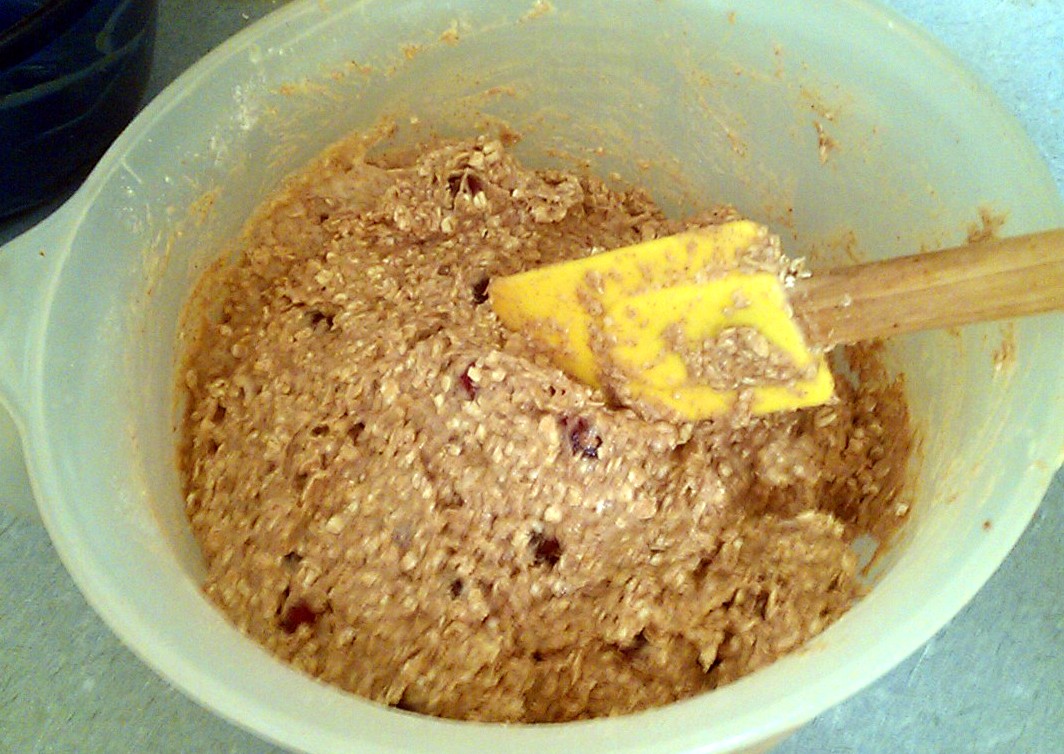
Stir in 3-1/2 cups of uncooked oats, ¼ cup of untoasted shredded coconut, and the flour mixture. When mixed, fold in 1 cup of fresh cranberries.


Drop by rounded tablespoons onto a parchment-lined cookie sheets. (For smaller cookies, drop rounded teaspoons of the mixture instead.)


Bake 12-15 minutes (a little less for the smaller cookies) or until golden brown, reversing the baking sheets half-way. (When putting two baking sheets in the oven at the same time, stagger them as in the photo for better heat circulation.)

Let the cookies cool for 5 minutes on the cookie sheets, then move them wire racks to finish cooling.


When the cookies are cool, make the frosting by combining 1 cup of confectioner’s sugar and 1-1/2 tablespoons of raspberry liqueur or other flavoring liqueur or fruit juice. (Don’t apply the frosting to warm cookies.)
Mix the frosting until smooth.


Using a spoon, drizzle the frosting on the cookies, and let harden before serving. (Placing wax paper under the cooling racks before applying the frosting is recommended.)
I found these cookies can be pretty addictive. You’ve been warned!

Looking forward to meeting again next week for another fun, delicious recipe! Till then, stay well, keep it about the food, and always remember to kiss the cook. ;-)