To download a copy of the recipe for Hamantaschen Pastry
with Apricot Filling, click HERE.
 Although hamantaschen (HAH-mehn-tah-shen) is a pastry
originating in the Hebrew celebration of Purim, there is no question it also
stands on its own as a valid baked treat people of all cultures, and from all
over the world, can enjoy year-round. To paraphrase a popular saying, all
people eat pastry in the same language.
Although hamantaschen (HAH-mehn-tah-shen) is a pastry
originating in the Hebrew celebration of Purim, there is no question it also
stands on its own as a valid baked treat people of all cultures, and from all
over the world, can enjoy year-round. To paraphrase a popular saying, all
people eat pastry in the same language.
It is important to note that, while you can go to many food
markets and bakeries this time of year and find something they’re
calling hamantaschen, don’t be fooled. In most cases, what you’re seeing is a counterfeit,
and a poorly made one at that, consisting of a triangular shortbread or butter
cookie filled with cheap jelly. Authentic hamantaschen is made from a lighter,
tastier pastry, generally with citrus or almond overtones, with a sweet
filling. Prune or sweet poppy seed fillings are the most traditional, although
apricot, as used in the recipe below, has come to be widely used as well.
Some Cook’s Notes before we begin:
- If you’re not inclined to make the filling from
scratch, a jar of good quality jam will work well. Go with any flavor you like;
there’s no need to be a slave to tradition here. These are your pastries.
- As with any pastry dough, the colder it is, the
easier it handles. Keep the dough cold while you’re working with it; cut, fill
and form the pastries as quickly as you can, even putting the dough or cutouts into
the freezer briefly if necessary. You’ll be glad you did.
- While we’re on the subject of working with the
dough, here are a couple of tips to help when folding up the sides to form the
pastries. To lift the sides to make the triangle, I find slipping a knife
underneath and using it to fold up the side is a lot easier than using my
fingers. (This also helps keep your hands from warming the cold dough
prematurely.) Also, when pressing the corners together to seal them, I find it
helpful to let one of the sides extend a little past the other, allowing you to
roll it over slightly before pressing them together and sealing with wet
fingers.
- To make the filling in this recipe, we’re using
water to rehydrate dried apricots. For an extra special touch, rehydrate the apricots
with orange juice instead.
- Finally, for those interested in hamantaschen’s
historical back-story, here’s the short version. (Biblically-inclined readers
will find the full version in the book of Esther.) Haman (as in “Hey, man!”),
an advisor to King Ahasuerus of Persia, created a plot to exterminate all the
Hebrews in the kingdom. When it turned out one of those Hebrews was Queen
Esther, the King’s favorite wife, the plot was foiled and everyone - except
Haman after the King got hold of him - lived happily ever after. And what might
otherwise have been a solemn observance somehow became a traditionally
carnival-like celebration, part of which involves mocking Haman by eating
pastries that are not only named after him, but also are shaped to resemble his
trademark three-corner hat. (In addition to being a racist tyrant, it turns out
Haman was also a fashion icon. Go figure.)
This recipe makes about twenty-eight 3-1/2” hamantaschen.
First,
we’ll make the pastry dough:
 Sift
4 cups of all-purpose flour, 2 tsp baking powder, and ½ tsp salt together into
a large bowl.
Sift
4 cups of all-purpose flour, 2 tsp baking powder, and ½ tsp salt together into
a large bowl.
 In
a separate bowl, beat 1 cup of sugar and 3 egg-substitute eggs until creamy.
In
a separate bowl, beat 1 cup of sugar and 3 egg-substitute eggs until creamy.
 Add
the egg-substitute eggs, the zest and juice of ½ lemon, and 1-1/2 tsp vanilla
to the butter mixture. Whisk to combine.
Add
the egg-substitute eggs, the zest and juice of ½ lemon, and 1-1/2 tsp vanilla
to the butter mixture. Whisk to combine.
 Add
the wet ingredients to the flour mixture.
Add
the wet ingredients to the flour mixture.
 Mix until a dough forms.
 Turn
the dough out onto a floured surface and knead for a minute or two until
smooth. (Be careful not to overwork the dough.)
Turn
the dough out onto a floured surface and knead for a minute or two until
smooth. (Be careful not to overwork the dough.)
 Flatten
the dough into a disk, wrap in plastic wrap, and place in the freezer for about
half an hour while you make the filling.
Flatten
the dough into a disk, wrap in plastic wrap, and place in the freezer for about
half an hour while you make the filling.
While
the dough is chilling, let’s make the apricot filling.
 Put 1-1/4 cups (tightly packed) of dried apricots, ¼ cup sugar, and the juice
and zest of ½ lemon in a medium sauce pan, and add just enough water to cover
the apricots. Bring the mixture to a boil, then reduce to a simmer for about 10
minutes to soften.
Put 1-1/4 cups (tightly packed) of dried apricots, ¼ cup sugar, and the juice
and zest of ½ lemon in a medium sauce pan, and add just enough water to cover
the apricots. Bring the mixture to a boil, then reduce to a simmer for about 10
minutes to soften.
 After
the apricots have softened, drain out the water and mash the apricots well.
After
the apricots have softened, drain out the water and mash the apricots well.
 Add
the ½ tsp cinnamon, a pinch of nutmeg, ¼ cup of raisins, and 1 Tbsp of honey to
the mashed apricots and mix well to form the filling. Set aside till needed.
Add
the ½ tsp cinnamon, a pinch of nutmeg, ¼ cup of raisins, and 1 Tbsp of honey to
the mashed apricots and mix well to form the filling. Set aside till needed.
When
you’re ready to form and bake the hamantaschen:
Preheat the oven to 375 degrees.
 Cut
the dough into quarters. Working one quarter at a time (and placing the re-wrapped
remaining dough back in the freezer so that it stays firm and easy to use),
place the dough on a well floured surface, and roll it out to 1/8” thick.
Cut
the dough into quarters. Working one quarter at a time (and placing the re-wrapped
remaining dough back in the freezer so that it stays firm and easy to use),
place the dough on a well floured surface, and roll it out to 1/8” thick.
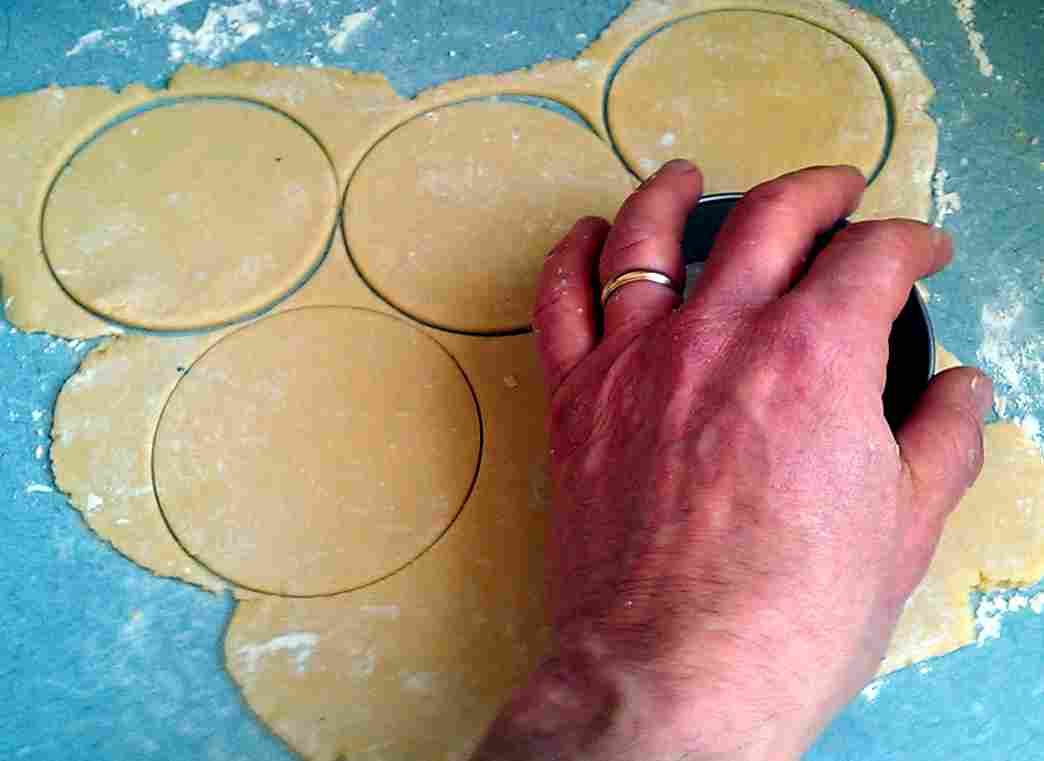
 Use
a cookie cutter to cut out 3-1/2” circles. Gather up the unused scraps; after
all four quarters of your dough have been rolled, cut and formed into pastries,
you can combine the scraps and get a second rolling out. (Don’t do a third
rolling after that, however. The gluten in the flour will be too developed by
that point and your dough will have started to become tough.)
Use
a cookie cutter to cut out 3-1/2” circles. Gather up the unused scraps; after
all four quarters of your dough have been rolled, cut and formed into pastries,
you can combine the scraps and get a second rolling out. (Don’t do a third
rolling after that, however. The gluten in the flour will be too developed by
that point and your dough will have started to become tough.)
 As you cut each cirlce, place it on a baking sheet lined with parchment or a
silicon baking pad. Repeat for the remaining portions of the dough. (You’ll
probably have to form and bake the pastries in batches.)
As you cut each cirlce, place it on a baking sheet lined with parchment or a
silicon baking pad. Repeat for the remaining portions of the dough. (You’ll
probably have to form and bake the pastries in batches.)
 Combine
one egg-substitute egg with one Tbsp water to form an egg wash.
Combine
one egg-substitute egg with one Tbsp water to form an egg wash.
 Place
a generous teaspoon of filling in the center of the circle.
Place
a generous teaspoon of filling in the center of the circle.
 Fold
two of the sides up to form two sides of a triangle. Using moistened fingers,
press the edges together to seal. (Refer to the Cook’s Notes above for tips on
doing this.)
Fold
two of the sides up to form two sides of a triangle. Using moistened fingers,
press the edges together to seal. (Refer to the Cook’s Notes above for tips on
doing this.)
 Fold
the third side up to complete the triangle and, using moistened fingers, press
the edges together to seal. Brush
each formed pastry with an egg wash.
Fold
the third side up to complete the triangle and, using moistened fingers, press
the edges together to seal. Brush
each formed pastry with an egg wash.
 Sprinkle
lightly with turbinado sugar (Sugar in the Raw or similar).
Sprinkle
lightly with turbinado sugar (Sugar in the Raw or similar).
 Bake
until golden, about 16 minutes, turning the baking sheet half-way for even
baking.Let
rest on the baking pan for a few minutes, then transfer to a cooling rack.
Bake
until golden, about 16 minutes, turning the baking sheet half-way for even
baking.Let
rest on the baking pan for a few minutes, then transfer to a cooling rack.
To download a copy of the recipe for Hamantaschen Pastry
with Apricot Filling, click HERE.
In
the early 1960’s, a famous series of bread advertisements advised, “You don’t
have to be Jewish to love Levy’s Real Jewish Rye.” It was true. And so it is
with the fresh baked deliciousness of apricot-filled hamantaschen pastry.
Enjoy, my friends. No matter where you are in the world, or what faith, if any,
you call yours, enjoy.
Be
sure to visit again next week for another great-tasting, home-cook friendly, and
entirely non-sectarian recipe. Till then, stay well, keep it about the food,
and always remember to kiss the cook. ;-)
 It seems fair to say that the macaroons with which most
people are familiar are the pasty, bland kind that are mass-produced and sold in cans. And that’s
a great shame, because really outstanding macaroons – soft, sweet and flavorful
– are one of the easiest treats you can make in your kitchen.
It seems fair to say that the macaroons with which most
people are familiar are the pasty, bland kind that are mass-produced and sold in cans. And that’s
a great shame, because really outstanding macaroons – soft, sweet and flavorful
– are one of the easiest treats you can make in your kitchen.Preheat the oven to 350 degrees.

In a bowl, combine the flour (or cake meal), ¼ tsp salt, sugar, and 1 Tbsp orange zest.

In another bowl, combine the egg whites with the remaining ¼ tsp salt. Beat until firm peaks form.

Add the flour mixture, a little at a time, to the beaten egg whites, mixing thoroughly after each addition.

When all of the flour mixture has been incorporated into the beaten egg whites, fold in the coconut and almonds.

Drop heaping tablespoons of the mixture onto a baking sheet lined with parchment or a silicon baking pad.

Using a wet finger, form a well in each piece.

Bake for about 18 minutes or until lightly browned, turning the baking sheet half-way for even baking. When turning the baking sheet, sprinkle the remaining zest on the partially baked macaroons.

Let the macaroons cool on the baking sheet for two minutes, then transfer to a cooling rack.