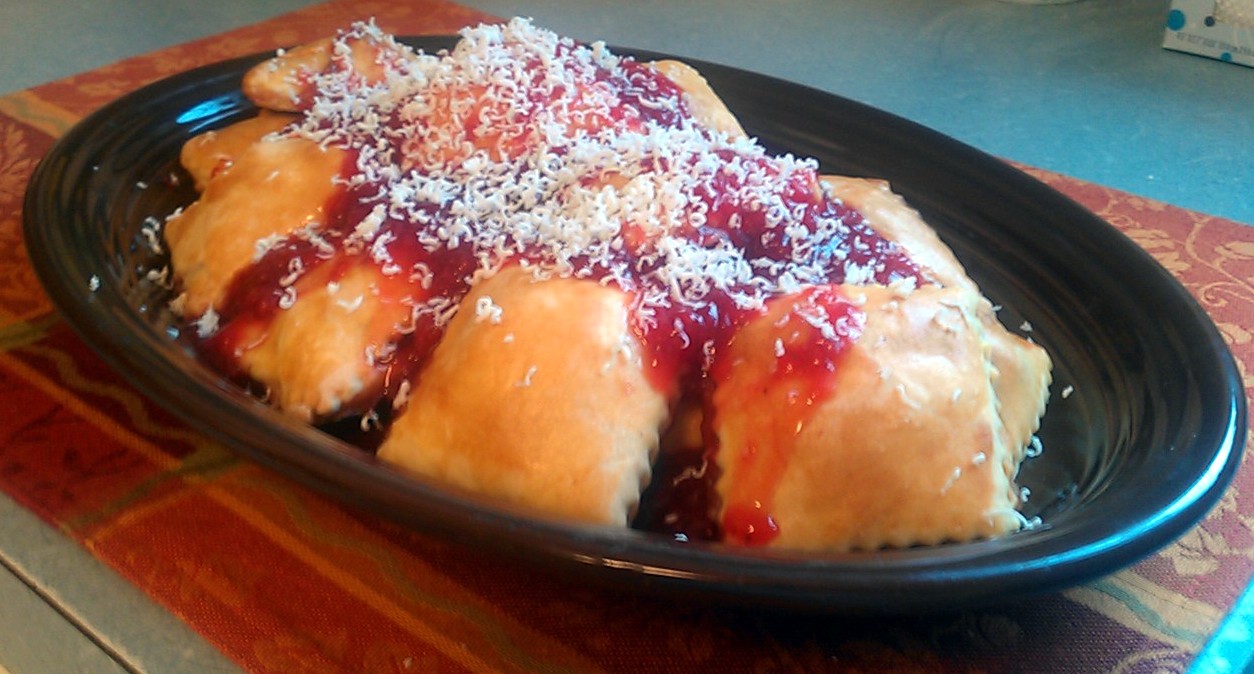
The origins of Strawberry-Rhubarb Pastry Ravioli go back several years. I was preparing a pie and had leftover dough trimmings. Such leftovers are normal, of course, but I was determined not to waste anything, even the scraps. I think when you make the dough yourself you feel a little parental toward it and want to give it every chance to make something of its life.
Whatever the reason, I took small roll-outs of the dough, placed some preserves on them, topped them with another small dough roll-out, and baked it till it looked something like a ravioli. They tasted pretty good. Elated and proud, yet disarmingly modest for someone who had just revolutionized the culinary world, I took time out from writing the speech I was going to give when awarded the Nobel Prize for Pastry to showed my great invention to my wife. She informed me that baking preserves between two pieces of pie dough was something mothers had been doing with small children to keep them occupied for about as long as there have been preserves, pie dough and, for that matter, small children.
Oh well, I thought. Back to the cutting board.
Despite the idea’s childish roots (or maybe because of them), it stayed in my head until, a couple of weeks ago, Facebook friend and, let me be sure to mention, award-winning and published baker Isabel asked me when I was next going to have a recipe for something sweet. It seemed a chance to explore the pastry ravioli idea again, this time bringing more experience to the process and taking it up a level or two. Experience, in this case, meaning:
- Using a strawberry-rhubarb filling instead of jarred preserves;
- Cutting the pastries with a ravioli cutter and topping them with fresh strawberry syrup made to resemble tomato sauce; and
- Topping the “sauce” with shaved white chocolate to resemble fresh-grated parmesan.
I’ve always said one of my favorite ingredients is whimsy. Fun food tastes good!
This recipe makes about sixteen 2-1/2” pastries. You’ll need two pie doughs which you can either buy, make using your favorite recipe, or click on the link for a reduced fat pie dough that really works.
Start by hulling one pound of fresh strawberries and dividing them into two equal piles, one for the filling and one for the topping.
 To make the filling, combine the following in a bowl, mix well, and cover and refrigerate until ready to use: ½ pound of the strawberries, finely chopped; 1-1/2 cups (about 1-1/2 large stalks) of red rhubarb, finely chopped; ¾ cup sugar; 1-1/2 tablespoons of corn starch; ½ tablespoon of all-purpose flour; ¼ teaspoon fresh lemon zest; ¼ teaspoon fresh lemon juice; ¼ teaspoon cinnamon; and ½ teaspoon vanilla extract.
Begin preheating the oven to 425 degrees.
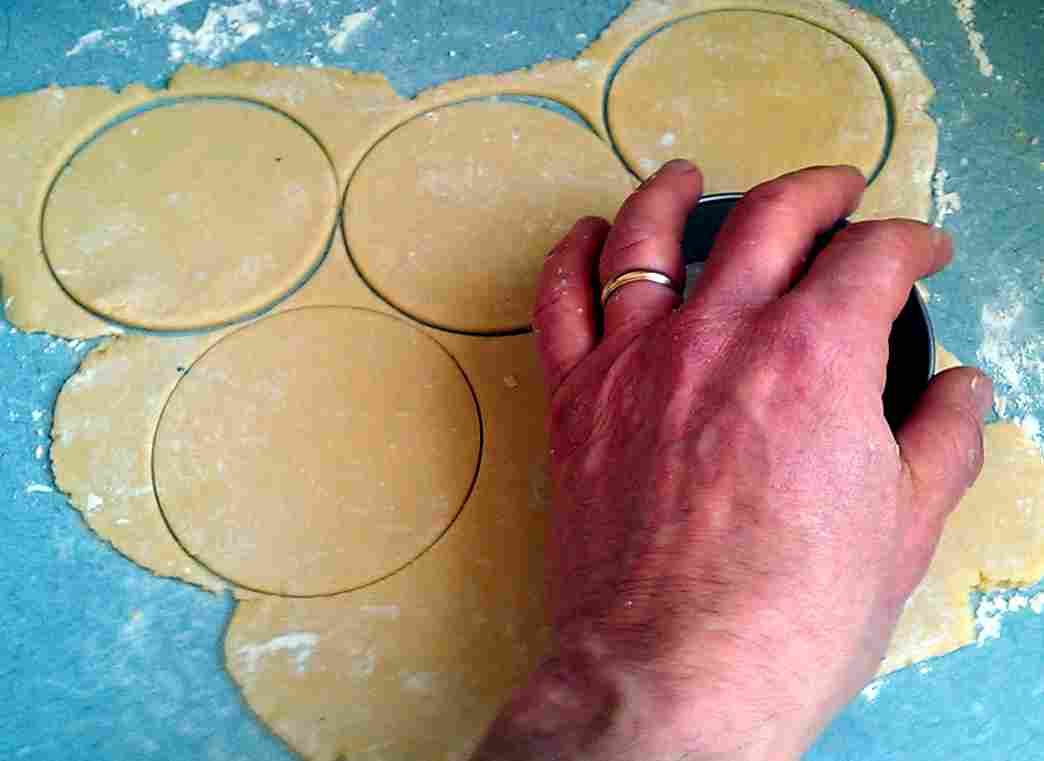
 On a floured surface, roll one of the pie doughs into a thin pastry. Being careful not to cut the dough, use a ravioli cutter to lightly mark where the dough will be cut into individual pieces. Lay out as many pieces as possible.
 Draining each spoonful as much as possible, place about a teaspoon of filling onto the center of each marked piece. (You will probably have filling left over.) Place a small dab of butter substitute on top of each mound of filling.
 On another floured surface, roll out the other pie dough to the same thickness as the first. Place the second dough on top of the first and lightly press down around the mounds formed by the filling.
 Brush an egg wash (1 tablespoon of water mixed with either one egg substitute egg or 1 beaten fresh egg) to the top dough. With the mounds as a guide, use the ravioli cutter to cut separate pastries that look like ravioli. Place the pastries on a parchment-lined baking sheet.
 Bake the pastries at 425 for 10 minutes. Lower the temperature to 375 degrees and bake until lightly golden, about 35 minutes, turning the baking sheet half-way.
While the pastries are baking, let’s make our strawberry “sauce” topping.
Place a small glass plate in the freezer. (This method of checking the final cooled thickness of the topping while it’s still hot comes to us from the world of jelly-making.)
Place ½ cup of sugar and the juice of ½ lemon into a medium saucepan. Mix until combined, then heat over a low heat until the sugar mixture is melted. (Keep an eye on it; you don’t want this to burn.)
Crush the remaining ½ pound of hulled strawberries by hand into the saucepan. (Crushing by hand will give the finished topping a lightly chunky appearance similar to tomato sauce.) Add a pinch of nutmeg and ½ tablespoon of butter substitute. Cook the mixture down to the desired “sauce” thickness. (You can check the thickness of the cooled liquid by placing a few drops of the hot liquid onto the plate you put in the freezer and letting it cool.)
When the pastries and topping are done, let them rest until cool.
The cooking is done; now it’s time for the stagecraft.
After the pastries and topping have cooled, lay the pastries on a serving plate similar to ravioli and top with the strawberry “sauce.” Shave white chocolate on top of the sauce, giving it an appearance similar to parmesan cheese on tomato sauce.
As always, if you prefer a cookbook-style, notebook-ready version of this or any other recipe you see here, just give a holler (along with your e-mail address) and I’ll get it right out.
See you next week with another recipe for something tasty and reduced fat! Till then, stay well, keep it about the food, and always remember to kiss the cook. ;-)
 It seems fair to say that the macaroons with which most
people are familiar are the pasty, bland kind that are mass-produced and sold in cans. And that’s
a great shame, because really outstanding macaroons – soft, sweet and flavorful
– are one of the easiest treats you can make in your kitchen.
It seems fair to say that the macaroons with which most
people are familiar are the pasty, bland kind that are mass-produced and sold in cans. And that’s
a great shame, because really outstanding macaroons – soft, sweet and flavorful
– are one of the easiest treats you can make in your kitchen.Preheat the oven to 350 degrees.

In a bowl, combine the flour (or cake meal), ¼ tsp salt, sugar, and 1 Tbsp orange zest.

In another bowl, combine the egg whites with the remaining ¼ tsp salt. Beat until firm peaks form.

Add the flour mixture, a little at a time, to the beaten egg whites, mixing thoroughly after each addition.

When all of the flour mixture has been incorporated into the beaten egg whites, fold in the coconut and almonds.

Drop heaping tablespoons of the mixture onto a baking sheet lined with parchment or a silicon baking pad.

Using a wet finger, form a well in each piece.

Bake for about 18 minutes or until lightly browned, turning the baking sheet half-way for even baking. When turning the baking sheet, sprinkle the remaining zest on the partially baked macaroons.

Let the macaroons cool on the baking sheet for two minutes, then transfer to a cooling rack.