Showing posts with label fish. Show all posts

Saturday, February 2, 2013

Landlubber Cioppino


To download a copy of the recipe for Landlubber Cioppino, click HERE.


In its original form, Cioppino was a stew made from the bounty brought to the San Francisco waterfront by returning fishing boats. Fresh-caught fish and shellfish – often served in the shell – were cooked in a tomato and wine broth and served with good bread. As this delightful meal made its way inland, catch-of-the-day often got replaced by seafood from the freezer case, but the result was still a hot delicious combination of several different fish and shellfish.


Here in Jersey City, we have a waterfront too. It’s just generally considered best not to eat most of what you might catch there. And so came the inspiration for this week’s recipe: Landlubber Cioppino. Blending shrimp, beef, chicken and sausage in a tomato and wine broth, it’s a land-based meal soup with the soul of a stew. Serve it with a good bread on the side (and a glass of the wine used to make the broth), and you’re ready to take the chill out of the coldest winter night.


Some Cook’s Notes before we begin:


  • You’ll note the recipe calls for chicken drumsticks. This is an homage to the in-shell crab, mussels, etc. used to make the original Cioppino. If you prefer to use a boneless cut of chicken, feel free.

  • When stewing the beef, I have to warn you: an hour and forty-five minutes of simmering an uncovered skillet of tomato-juice covered meat will spatter on your stove. Not to worry; a moist sponge takes it right off.


This recipe makes about 6 meal-size servings.


To stew the beef:


Season ¼ cup of all-purpose flour with salt and pepper.


Pat 1 to 1-1/4 lbs. of stew beef cubes dry with a paper towel. Dredge them in the flour mixture to coat, shaking off excess flour.


Heat 2 Tbsp of oil in a large skillet. Brown the beef very well on all sides, then remove to a plate.


Add enough of a 46 ounce bottle of tomato juice to cover the beef. Add 1/2 teaspoon hot sauce, 1-1/2 tablespoons Worcestershire sauce, 1 tablespoon balsamic vinegar, and 1 tablespoon spicy brown mustard.
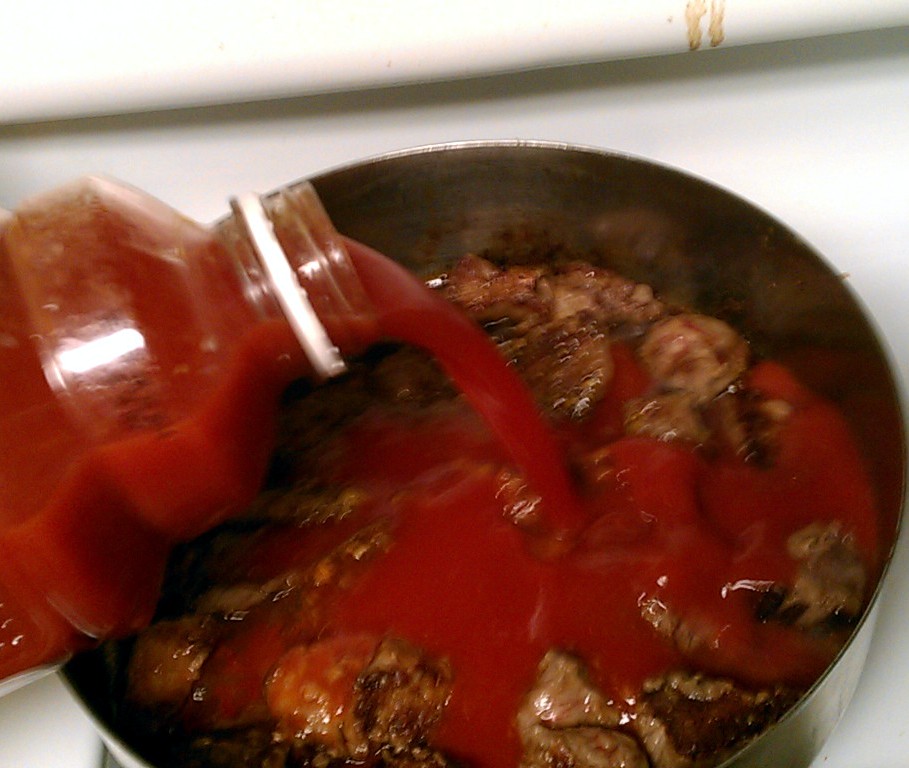


Mix well, scraping up the brown bits from the bottom of the skillet, and bring to a simmer.


Simmer uncovered until the meat is fork tender, about 1-3/4 hours. Add more of the tomato juice as needed during the stewing to keep the meat covered. (If you run out of juice and need to add more liquid, water can be used.) Season with salt and pepper to taste. Set aside till needed.


While the beef is stewing:


Warm 2 Tbsp of olive oil in a grille pan over medium heat. Brown 1-1/4 lb. of turkey sausages on all sides.


Begin preheating the oven to 350 degrees.


When the sausages have finished browning, wrap in foil and set aside.


Pat the 1 to 1-1/4 lbs. of chicken drumsticks dry with a paper towel. Add a little salt. Brown them on the same grille pan you used for the sausages. (They should be well browned, but don’t have to be cooked through, since they’re going into the oven after this.)
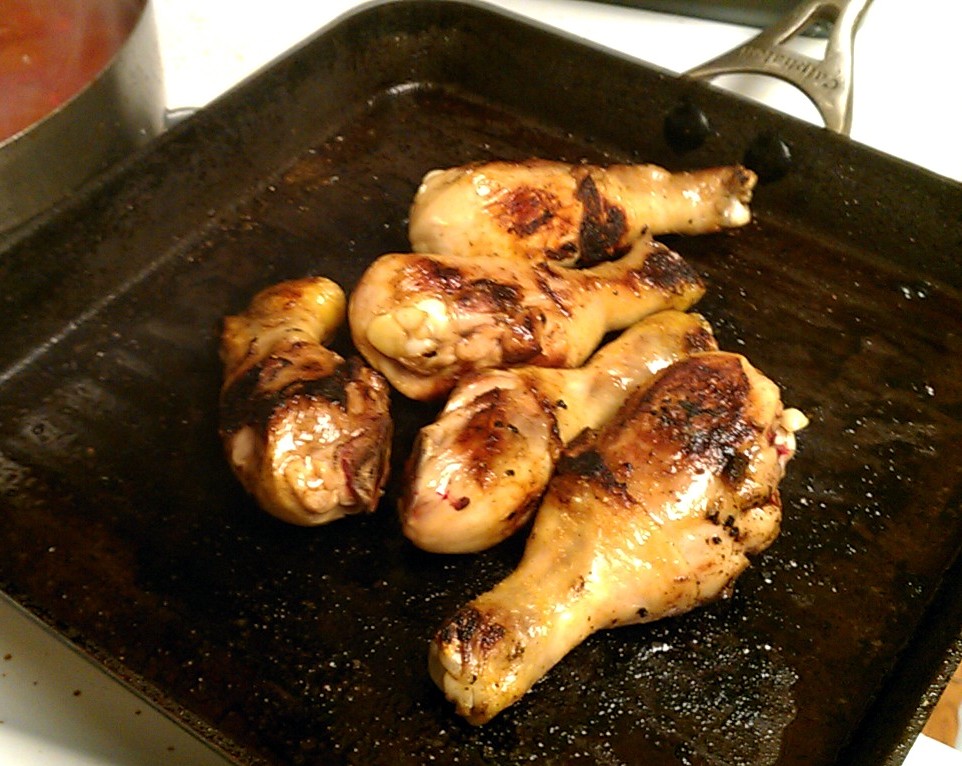


After the drumsticks have browned in the grille pan, wrap them in foil and place in the oven for 30 minutes..


After the beef has been stewing for about an hour, warm 3 Tbsp of olive oil in a large soup pot over medium heat. Add 1 large diced onion to the large pot and cook till translucent.


Add 4 minced cloves of garlic and cook till fragrant, about another 30 seconds to 1 minute. Add 2 tsp salt, a 28 ounce can of diced tomatoes (including juice), ½ tsp hot sauce, 1-1/4 cup dry white wine (chardonnay or similar), 4 cups chicken stock, and 1 bay leaf. Stir to combine.


Cover the large pot, bring to a boil, then reduce the heat to a simmer. Simmer covered for 30 minutes.


While the soup liquid is cooking, slice the sausages into 1-1/2” pieces.


After the soup liquid has finished simmering, add the browned chicken, browned beef, browned sausage, 1 lb. uncooked shrimp (shelled and deveined), ½ tsp dried oregano, ½ tsp dried thyme, ½ tsp dried basil, and 2 Tbsp dried parsley.


Bring to a boil, then simmer uncovered for an additional five minutes until the shrimp is cooked through.


Divide into bowls, making sure every portion gets all four types of protein. Serve with a good bread and a glass of the chardonnay you used to make the soup liquid.


To download a copy of the recipe for Landlubber Cioppino, click HERE.


Now that should keep you warm this winter!
 

That’s it for this week. Please visit again next week for another kitchen-tested, home-cook friendly recipe. Till then, stay well, keep it about the food, and always remember to kiss the cook. ;-)

Saturday, September 1, 2012

Shrimp Risotto a la Sushi

To download a copy of the recipe for Shrimp Risotto a la Sushi, click HERE.


In spite of how it might sometimes appear, I don’t set out to make recipes that are a little bit strange. Sometimes they just happen. This week’s recipe is not only a unique way to serve risotto; it’s a whole new way of looking at it.

The basic idea is this: prepare your risotto as you normally would, along with some shrimp and asparagus. Only this time, roll the risotto around the shrimp and asparagus in the style of sushi. (Risotto’s starchy texture makes it a natural for doing this.) To add to the effect, use steamed spinach to replace the nori (seaweed) often used to wrap sushi; and use pesto and marinated carrot ribbons to replace the wasabi sauce and pickled ginger that are normally on a sushi plate. (Depending on your sense of theatrics, you may want to plate it in a sushi-type container and provide chopsticks as in the photo at the top.) It’s a great way to change up your risotto and keep it so interesting for your family that you might even find yourselves talking to each other at the dinner table!

Some Cook’s Notes before we begin.
  • As you’ll see in the recipe, you don’t need a bamboo sushi mat to make the risotto sushi. Parchment lightly sprayed with cooking spray will serve our purpose.
  • Rolling the sushi is not difficult, but it helps to watch any of the many good tutorial videos available on You Tube.
  • While it’s possible to cook and serve the carrot ribbons without marinating them, I wanted to represent the cleansing acidity of the pickled ginger normally served with sushi. For this reason, the marinade itself has a little extra vinegar when compared to typical vegetable marinades.

This recipe makes four meal-size servings.

Let’s start by making the risotto:

Warm 4 cups of fish stock or vegetable stock in a saucepan over low heat.


Put 2 Tbsp of olive oil in a sauté pan and sauté the 1 green or red bell pepper and 1 small onion, both finely chopped. When they are cooked through, and 4 minced garlic cloves and cook until aromatic, about another 30 seconds to a minute.


Add 1 cup of Arborio rice and 2 Tbsp of chopped, fresh oregano, and cook for 2 – 3 minutes, stirring constantly.


Add ¾ cup of dry white wine (Chardonnay or similar) to the sautĂ© pan and cook until the liquid is absorbed.


Add the stock, ½ cup at a time, stirring constantly and waiting till the liquid is absorbed before adding more. (Constant stirring helps release the starches in the rice. This gives the risotto its signature creamy texture and is an important part of the risotto method.)


When all the broth is absorbed, remove the skillet from the heat. Stir in ½ cup of shredded or grated parmesan till the cheese is completely incorporated, and add salt and pepper to taste. Set aside while you prepare the rest of the dish.

Next, we’ll make the marinated carrot ribbons:


Wash and trim 3 or 4 large carrots, and cut them in half length-wise. Using a wide peeler on the flat side of the cut carrots, slice each carrot into ribbons. Cut the long ribbons in half so that all the pieces are 3" - 4" long.


To make the marinade, combine 1/3 cup of white wine vinegar; 1 minced garlic clove; ¼ cup chopped fresh basil; and 2 Tbsp chopped fresh oregano in a small bowl. Drizzle in ¾ cup of olive oil while whisking rigorously till the marinade has a smooth consistency. Add salt and pepper to taste.


Place the carrot ribbons in a sealable plastic storage bag, and add the marinade. Let the carrots marinate while you continue with the rest of the recipe.


While the carrots are marinating:

If using the spinach, place one pound in a large pot fitted with a steamer basket. Steam the spinach till cooked through. (This should only take a few minutes.) Drain well and set aside.


Place ½ pound of fresh asparagus in a bowl, drizzle with olive oil, and season with salt and pepper.


Cook the asparagus until cooked but firm. Set aside.


Place one pound of peeled, uncooked shrimp in a bowl, drizzle with olive oil, and season with salt and pepper. Cook the shrimp through, using skewers soaked in water to make turning them over easier. Be careful not to overcook them. When done, set the shrimp aside.


Use the same pan to cook the marinated carrots to desired doneness.


To assemble the risotto “sushi”:


Place half of the risotto on a sheet of parchment, lightly sprayed with cooking spray.Place another sheet of lightly sprayed parchment on top of the risotto and roll it out to a rectangle about 7” x 9”.


If necessary to get a good rectangle, cut away some of the rolled risotto and locate it where needed to make the rectangle.


If using the spinach, spread half of the spinach evenly over the top of the risotto.


If using the spinach, put the sprayed parchment back on top and turn the assembly over together as a unit, so that the spinach is now on the bottom surface of the risotto rectangle. Remove the top parchment sheet.


Place half the asparagus and half the shrimp along the middle of the rectangle.


Lifting the parchment sheet, carefully roll the risotto sheet around the shrimp and asparagus filling.


Press down to seal the risotto.


Carefully remove the parchment sheet. Slice the rolled risotto into 1-1/2” pieces.

Repeat the above steps with the other half of the risotto, asparagus, shrimp, and optional spinach.


If desired, place the risotto “sushi” pieces on a baking sheet and warm in a 350 degree oven. (In the photo, you'll see I made half of mine with the spinach wrap, and half without.)


To serve, place three of the pieces on a dish with ¼ of the carrots and 2 Tbsp pesto.


To download a copy of the recipe for Shrimp Risotto a la Sushi, click HERE.


Now that’s food that’s fun and delicious!

Hope you’ll come back next week for another great tasting recipe! Till then, stay well, keep it about the food, and always remember to kiss the cook. ;-)


Friday, September 16, 2011

Cornmeal Crusted Baked Fish, Buttermilk and Roasted Garlic Mashed Potatoes with Rosemary, and a How-to-Fillet Tutorial Video

As you can tell by the long title, dear readers, there's lots going on this week.

Wanting to use the low-fat buttermilk left after making last week’s Oven Fried Green Tomatoes, a couple of days later I put together a dinner that used it for both freshly-filleted fish and mashed potatoes. So this week, you’re getting not one, not two, but three featured items…

  • Cornmeal Crusted Baked Fish
  • Buttermilk and Roasted Garlic Mashed Potatoes with Rosemary, and
  • A tutorial video on cutting your own fish fillet for the baked fish recipe!
The photo at right also includes homemade herbed buttermilk biscuits (click here for the recipe) and another favorite side dish, asparagus bundles, gently seasoned asparagus wrapped in glorious bacon (or, in this case, glorious low-fat turkey bacon). The vegetable bundles side dish is from a Paula Deen recipe (using green beans) that you’ll find at

So let’s get started!

First, you’re going to need fish fillets. You can buy them, of course, but paying for a package of fish at the supermarket doesn’t make for a very interesting video. And so, for those so inclined, here’s how to fillet your own.


Now that you’ve got your fillets, either by buying some or cutting them yourself, let’s make the rest of dinner. (The recipes below make four servings.) Fish generally cooks fairly quickly, so we’ll do the mashed potatoes first. This recipes uses baked potatoes instead of the usual boiled ones; as with most dishes normally made with boiled potatoes, baking the potatoes gives a deeper flavor that really adds something extra.

Preheat the oven to 400 degrees.

Place 4 russet potatoes on a baking sheet and perforate with a fork. Bake for 45 – 60 minutes until a fork penetrates easily.

While the potatoes are baking, prepare the roasted garlic (which has a wonderful sweet, creamy texture useful for many dishes) as follows:

Slice the top off two heads of garlic, leaving the papery skin on. (Slice off enough to expose some of the garlic inside.)

Place the garlic heads on foil. Drizzle with olive oil and ½ teaspoon of white wine vinegar. Wrap the foil around the garlic heads and roast in the oven with the potatoes till lightly browned and soft, about 30 minutes. When done, set aside until needed.

When the potatoes have finished baking, cut into cubes, and put them and the roasted garlic through a food mill and into a bowl. (You can use a masher instead, but the food mill gives a smoother texture that works especially well with the roasted garlic and the buttermilk we’ll be adding in the next step.)

Once the potatoes and garlic are in the bowl, add the ¾ cup of butter substitute, ½ cup low-fat buttermilk, and 1 tablespoon of dried rosemary, and mix till smooth. Add salt and pepper to taste.

Now let’s prepare the fish:

Preheat the oven (or, if you made the potatoes, increase the temperature) to 450 degrees.

Pour ½ cup of low-fat buttermilk into a shallow pan. Put four serving-size fish fillets into the milk and let sit for 15 minutes.
While the fish is resting in the milk, prepare the breading by combine the following coating ingredients in another shallow pan or a sealable plastic bag: ½ cup cornmeal; 1 tablespoon kosher salt; ½ teaspoon fresh ground black pepper; 1 teaspoon garlic powder; 1 tablespoon dried parsley; 1 teaspoon dried thyme; 1 teaspoon dried rosemary; and the zest of 1 lemon or orange.
Working one fillet at a time, remove the fillets from the buttermilk and place them in the breading until well coated. Place each coated fillet on an oiled or parchment-lined baking sheet.

Bake until the fish is cooked and flaky, about 10-12 minutes, turning them over half way.

To serve, drizzle each filet with a little olive oil and garnish each plate with a lemon wedge.


And that should be plenty for one week!

Drop me a like if you’d like a cookbook-style copy of this recipe. (Be sure to include your e-mail address.) And be sure to visit again next week for another delicious, reduced-fat dish! Till then, stay well, keep it about the food, and always remember to kiss the cook. ;-)

Friday, January 7, 2011

Breaded Baked Italian Style Fish Fillets

Ciao amici!

This week’s recipe is a little unusual in that it’s the first of a two part combination. Like a good movie, a well-made dish has both a star and high-quality supporting players. My offering today is the star of the dish – a breaded Italian style baked fish fillet – and next week we’ll continue with a delicious (and just a bit unusual) brown rice side dish that goes especially well with it.

I’ve made this twice: once with scrod and once with pollock. Both worked equally well, and I expect any other white fish would too. I’ve not prepared other types of fish this way, but I have every reason to believe it would be successful as well. (I also might give this a try with chicken breasts some time soon.)

You'll see that the recipe is simple, and the result is delicious. A couple of notes before we begin will fill out some of the recipe’s details:
  • Before coating the fish with the seasoned bread crumb mixture, I seasoned the fish itself with a bit of olive oil, and a mix of salt, pepper and garlic powder. I like this much better than having all the seasoning in the breading since it distributes the flavor throughout the entire bite, rather than relying only on the breading.
  • Instead of plain bread crumbs, I like to give the breading a more varied texture by using a mixture of plain crumbs and panko. (Panko, for anyone unfamiliar with it, is made from bread without crusts and has a texture that is crisper than plain bread crumbs. Originally used in Japanese cooking, panko is now in common use all over and can usually be found at the supermarket right next to the plain breadcrumbs.) For me, plain breadcrumbs, while very good, seem to say, “Good evening. I’m your breaded coating and I’m going to help make eating this fish a pleasurable experience for you.” Using panko adds a bold crispness that grabs you by your collar and says, “Yeah, I’m the breading. You got a problem with that?”
To make four servings:
Preheat the oven to 450 degrees.

Dry the surface of four fish fillets using paper towels, then brush both sides of each fillet lightly with extra virgin olive oil. Make the fish seasoning by mixing 1 tablespoon of  kosher salt, ½ teaspoon of fresh ground pepper, and 1teaspoon of garlic powder, and apply it generously to both sides of each fish filet. (Any remaining seasoning mixture can be reserved to season whatever vegetables you’re serving with the fish.)
You’re now ready to bread the fish fillets. An easy way to do this without making a mess is to put the flour, seasoned bread crumb mixture and, if you like, even the egg substitute (or beaten eggs) into large sealable plastic food storage bags.
Place three pans (or the sealable bags) on the counter. In the first, put 1 cup of all purpose flour. In the second, put two egg substitute eggs (or two regular egg, well beaten). In the third, combine the following ingredients to make the seasoned bread crumb mixture: ½ cup panko bread crumbs, ½ cup plain bread crumbs, 2 tablespoons  of  dried basil, 2 tablespoons of dried oregano, 1 tablespoon of dried parsley, 1 teaspoon of dried thyme, 1 teaspoon of dried rosemary, and the zest of 1 lemon or orange.

Working one fillet at a time, put each fillet in the flour and coat well, then in the egg, then in the seasoned bread crumbs. Be sure both sides are well coated. As you finish breading each fillet, place it on a baking sheet lined with parchment.

Once all the fillets are coated, bake them until the fish is cooked and flaky, about 10-12 minutes, turning them over half way. To serve, drizzle each fillet with a little olive oil and garnish each plate with a lemon wedge to serve. (A glass of white wine won't hurt, either!)
So there you have part 1 of our delicious Italian-style dinner. Coming up next week in part 2: a special side dish I call “Brown Rice Rizzuto.”

As always, if you’d like a cookbook style, notebook ready copy of this week’s recipe, just let me know in a comment or an e-mail and I’ll send it along.

See you next week for part 2! Till then, stay well, keep it about the food, and always remember to baci il cuoco. ;-)